



dfx: Differentiable Tensor Programming Made Simple
dfx is a tensor library with support for differentiable programming. It is designed for use in machine learning, probabilistic programming, optimization and other domains.
Continuing DiffSharp
dfx is the continuation of DiffSharp, carrying its work forward with deep respect for the ideas, care, and contributions that established its foundation.
We offer our sincere thanks to Dr. Atılım Güneş Baydin for creating and leading DiffSharp and for his foundational contributions to differentiable programming in F#.
Key Features
🗹 Nested and mixed-mode differentiation
🗹 Common optimizers, model elements, differentiable probability distributions
🗹 F# for robust functional programming
🗹 PyTorch familiar naming and idioms, efficient LibTorch CUDA/C++ tensors with GPU support
🗹 Linux, macOS, Windows supported
🗹 Use interactive notebooks in Jupyter and Visual Studio Code
🗹 100% open source
Differentiable Programming
dfx provides world-leading automatic differentiation capabilities for tensor code, including composable gradients, Hessians, Jacobians, directional derivatives, and matrix-free Hessian- and Jacobian-vector products over arbitrary user code. This goes beyond conventional tensor libraries such as PyTorch and TensorFlow, allowing the use of nested forward and reverse differentiation up to any level.
With dfx, you can compute higher-order derivatives efficiently and differentiate functions that are internally making use of differentiation and gradient-based optimization.
Practical, Familiar and Efficient
dfx comes with a LibTorch backend, using the same C++ and CUDA implementations for tensor computations that power PyTorch. On top of these raw tensors (LibTorch's ATen, excluding autograd), dfx implements its own computation graph and differentiation capabilities. It is tested on Linux, macOS, and Windows, and it supports CUDA and GPUs.
The dfx API is designed to be similar to the PyTorch Python API through very similar naming and idioms, and where elements have similar names the PyTorch documentation can generally be used as a guide.
dfx uses the incredible F# programming language for tensor programming. F# code is generally faster and more robust than equivalent Python code, while still being succinct and compact like Python, making it an ideal modern AI and machine learning implementation language. This allows fluent and productive code for tensor programming.
Interactive Notebooks
All documentation pages in this website are interactive notebooks which you can execute directly in your browser without installing anything in your local machine.
Using the buttons on the top of each page, you can execute the page as an interactive notebook running on cloud servers provided by Google Colab and Binder.
Using the buttons
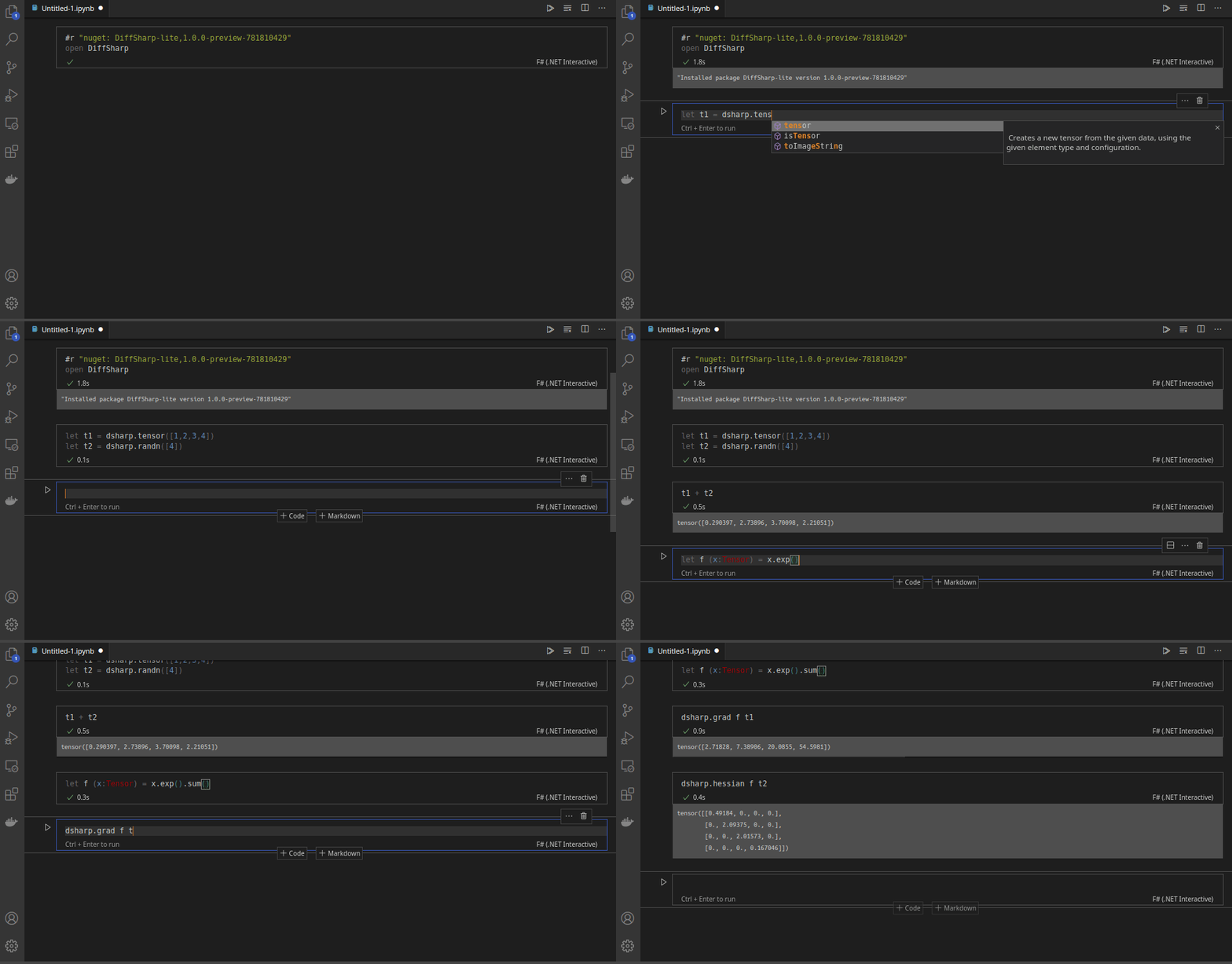
you can also download a page as a script or an interactive notebook, which you can execute locally in Jupyter or Visual Studio Code using dotnet interactive.
Example
Define and add two tensors:
open Dfx

let t1 = dfx.tensor [ 0.0 ..0.2.. 1.0 ] // Gives [0., 0.2, 0.4, 0.6, 0.8, 1.]
let t2 = dfx.tensor [ 1, 2, 3, 4, 5, 6 ]

t1 + t2
|
Compute a convolution:
let t3 = dfx.tensor [[[[0.0 .. 10.0]]]]
let t4 = dfx.tensor [[[[0.0 ..0.1.. 1.0]]]]

t3.conv2d(t4)
|
Take the gradient of a vector-to-scalar function:
let f (x: Tensor) = x.exp().sum()

dfx.grad f (dfx.tensor([1.8, 2.5]))
|
Compute a nested derivative (checking for perturbation confusion):
let x0 = dfx.tensor(1.)
let y0 = dfx.tensor(2.)
dfx.diff (fun x -> x * dfx.diff (fun y -> x * y) y0) x0
|
Define a model and optimize it:
open Dfx
open Dfx.Data
open Dfx.Model
open Dfx.Compose
open Dfx.Util
open Dfx.Optim

let epochs = 2
let batchSize = 32
let numBatches = 5

let trainSet = MNIST("../data", train=true, transform=id)
let trainLoader = trainSet.loader(batchSize=batchSize, shuffle=true)

let validSet = MNIST("../data", train=false, transform=id)
let validLoader = validSet.loader(batchSize=batchSize, shuffle=false)

let encoder =
    Conv2d(1, 32, 4, 2)
    --> dfx.relu
    --> Conv2d(32, 64, 4, 2)
    --> dfx.relu
    --> Conv2d(64, 128, 4, 2)
    --> dfx.flatten(1)

let decoder =
    dfx.unflatten(1, [128;1;1])
    --> ConvTranspose2d(128, 64, 4, 2)
    --> dfx.relu
    --> ConvTranspose2d(64, 32, 4, 3)
    --> dfx.relu
    --> ConvTranspose2d(32, 1, 4, 2)
    --> dfx.sigmoid

let model = VAE([1;28;28], 64, encoder, decoder)

let lr = dfx.tensor(0.001)
let optimizer = Adam(model, lr=lr)

for epoch = 1 to epochs do
    let batches = trainLoader.epoch(numBatches)
    for i, x, _ in batches do
        model.reverseDiff()
        let l = model.loss(x)
        l.reverse()
        optimizer.step()
        print $"Epoch: {epoch} minibatch: {i} loss: {l}"

let validLoss =
    validLoader.epoch()
    |> Seq.sumBy (fun (_, x, _) -> model.loss(x, normalize=false))

print $"Validation loss: {validLoss/validSet.length}"
Numerous other model definition, differentiation, and training patterns are supported. See the tutorials in the left-hand menu and examples on GitHub.
More Information
dfx carries forward DiffSharp, which was developed by Dr. Atılım Güneş Baydin, Don Syme and other contributors, having started as a project supervised by the automatic differentiation wizards Barak Pearlmutter and Jeffrey Siskind.
Please join us on GitHub!
<summary> Tensor operations </summary>
static member Dfx.dfx.config: configuration: (Dfx.Device * Dfx.Dtype * Dfx.Backend * Dfx.Printer) -> unit
static member Dfx.dfx.config: ?device: Dfx.Device * ?dtype: Dfx.Dtype * ?backend: Dfx.Backend * ?printer: Dfx.Printer -> unit
module Backend from Dfx
<summary> Contains functions and settings related to backend specifications. </summary>
--------------------
type Backend = | Reference | Torch | Other of name: string * code: int override ToString: unit -> string member Name: string
<summary> Represents a backend for dfx tensors </summary>
<summary> The reference backend </summary>
<summary> Represents a multi-dimensional data type containing elements of a single data type. </summary>
<example> A tensor can be constructed from a list or sequence using <see cref="M:Dfx.dfx.tensor(System.Object)" /><code> let t = dfx.tensor([[1.; -1.]; [1.; -1.]]) </code></example>
type MNIST = inherit Dataset new: path: string * ?urls: string seq * ?train: bool * ?transform: (Tensor -> Tensor) * ?targetTransform: (Tensor -> Tensor) * ?n: int -> MNIST override item: i: int -> Tensor * Tensor member classNames: string array member classes: int override length: int
--------------------
new: path: string * ?urls: string seq * ?train: bool * ?transform: (Tensor -> Tensor) * ?targetTransform: (Tensor -> Tensor) * ?n: int -> MNIST
type Conv2d = inherit Model new: inChannels: int * outChannels: int * ?kernelSize: int * ?stride: int * ?padding: int * ?dilation: int * ?kernelSizes: int seq * ?strides: int seq * ?paddings: int seq * ?dilations: int seq * ?bias: bool -> Conv2d override ToString: unit -> string override forward: value: Tensor -> Tensor member bias: Tensor with get, set member weight: Tensor with get, set
<summary>A model that applies a 2D convolution over an input signal composed of several input planes</summary>
--------------------
new: inChannels: int * outChannels: int * ?kernelSize: int * ?stride: int * ?padding: int * ?dilation: int * ?kernelSizes: int seq * ?strides: int seq * ?paddings: int seq * ?dilations: int seq * ?bias: bool -> Conv2d
static member dfx.flatten: input: Tensor * ?startDim: int * ?endDim: int -> Tensor
static member dfx.unflatten: input: Tensor * dim: int * unflattenedShape: int seq -> Tensor
type ConvTranspose2d = inherit Model new: inChannels: int * outChannels: int * ?kernelSize: int * ?stride: int * ?padding: int * ?dilation: int * ?kernelSizes: int seq * ?strides: int seq * ?paddings: int seq * ?dilations: int seq * ?bias: bool -> ConvTranspose2d override ToString: unit -> string override forward: value: Tensor -> Tensor member bias: Tensor with get, set member weight: Tensor with get, set
<summary>A model that applies a 2D transposed convolution operator over an input image composed of several input planes.</summary>
--------------------
new: inChannels: int * outChannels: int * ?kernelSize: int * ?stride: int * ?padding: int * ?dilation: int * ?kernelSizes: int seq * ?strides: int seq * ?paddings: int seq * ?dilations: int seq * ?bias: bool -> ConvTranspose2d
type VAE = inherit VAEBase new: xShape: int seq * zDim: int * encoder: Model * decoder: Model -> VAE override ToString: unit -> string override decode: z: Tensor -> Tensor override encode: x: Tensor -> Tensor * Tensor
<summary>Variational auto-encoder</summary>
--------------------
new: xShape: int seq * zDim: int * encoder: Model * decoder: Model -> VAE
static member dfx.tensor: value: obj * ?device: Device * ?dtype: Dtype * ?backend: Backend -> Tensor
type Adam = inherit Optimizer new: model: Model * ?lr: Tensor * ?beta1: Tensor * ?beta2: Tensor * ?eps: Tensor * ?weightDecay: Tensor * ?reversible: bool -> Adam override updateRule: name: string -> t: Tensor -> Tensor
<summary>TBD</summary>
--------------------
new: model: Model * ?lr: Tensor * ?beta1: Tensor * ?beta2: Tensor * ?eps: Tensor * ?weightDecay: Tensor * ?reversible: bool -> Adam
<summary> Print the given value to the console using the '%A' printf format specifier </summary>
module Seq from Dfx.Util
<summary> Contains extensions to the F# Seq module. </summary>
--------------------
module Seq from Microsoft.FSharp.Collections
© Copyright 2021, DiffSharp and dfx Contributors.